
Views: 254 Author: SJAVL Publish Time: 2026-11-25 Origin: Site


Content Menu
● What Are the Acoustic Requirements for a Live Streaming Studio? The Essential Checklist
● 1. Set Reverberation Targets for the Production Format
>> Match the Target to How the Room Will Be Used
● 2. Control Background Noise With All Systems Running
● 3. Separate Sound Isolation From Acoustic Treatment
>> Inspect the Entire Sound-Transmission Path
● 4. Design Broadband Treatment Around the Microphones
>> Choose Materials by Performance, Not Appearance
● 5. Treat Microphone Placement as Part of Acoustic Design
● 6. Address XR Studios, LED Walls, and Cooling Together
>> Build a Production-State Noise Plan
● 7. Turn Acoustic Requirements Into a Commissioning Plan
>> A Practical Five-Step Acceptance Process
● 8. Learn From Integrated Broadcast Projects Without Inventing Results
● 9. Prioritize the Budget Around the Biggest Acoustic Risks
>> What is the best reverberation time for a live streaming studio?
>> Do acoustic panels soundproof a streaming room?
>> Can a small room produce professional streaming audio?
>> Is a dynamic microphone better than a condenser microphone?
>> Can AI noise reduction replace acoustic treatment?
>> How should acoustic performance be checked before handover?
● Plan Your Live Streaming Studio With SJAVL
Guangzhou Saijia Acoustic & Lighting Engineering Co., Ltd. (SJAVL) approaches the question "What Are the Acoustic Requirements for a Live Streaming Studio?" as an integrated engineering challenge. Clear streaming audio requires low background noise, controlled reverberation, effective sound isolation, and microphone placement that keeps speech stronger than unwanted reflections.
Our company brings 26 years of experience across acoustic engineering, professional lighting and audio, stage machinery, LED displays, intelligent control, AV integration, and XR virtual-extension technology. As a turnkey EPC provider serving international venue owners and operators, we connect acoustic design with construction, installation, commissioning, and long-term support.
The starting point is simple: design the room around what viewers need to hear, not just what cameras need to see.

A speech-focused streaming studio should deliver intelligible, natural voices without distracting hum, excessive room sound, or audible interruptions.
However, no single acoustic specification suits every production. A close-miked presenter, a three-person interview, and a live music performance require different solutions.
| Acoustic requirement | Practical design objective | Verification |
|---|---|---|
| Background noise | Keep building services and production equipment unobtrusive | Measure with equipment operating |
| Reverberation | Produce clear speech without excessive lingering sound | Assess decay across frequency bands |
| Sound isolation | Limit disturbance from adjoining spaces and outdoors | Test relevant transmission paths |
| Early reflections | Reduce coloration from desks, walls, ceilings, and displays | Evaluate impulse response and recordings |
| Low-frequency control | Minimize booming, rumble, and prolonged bass decay | Inspect response and decay measurements |
| Microphone integration | Maintain consistent direct speech pickup | Rehearse actual presenter movements |
These objectives should become a written project brief before finishes or equipment are purchased.
Reverberation time describes how long sound takes to decay by 60 decibels after the source stops. Excessive reverberation can blur syllables and make speech sound distant.
For a small, speech-led streaming room, approximately 0.2–0.4 seconds can be considered an initial design discussion range—not a universal compliance requirement.
A crucial distinction: EBU Tech 3276 specifies a nominal reverberation range between 0.2 and 0.4 seconds for reference listening and high-quality sound control rooms. It does not establish a mandatory target for every streaming capture space.
Consider the production first:
- Solo commentary generally benefits from controlled, relatively dry speech.
- Interviews need consistent clarity across several microphone positions.
- Product demonstrations require intelligibility while presenters move.
- Music streaming may need adjustable absorption to preserve useful ambience.
The objective is balanced decay, not the shortest possible number.
A room can sound dull at high frequencies while remaining boomy in the bass. For that reason, frequency-dependent measurements matter more than one attractive average.
A studio that sounds quiet before production may become noisy once lighting, cooling, computers, and displays are operating.
Typical sources include:
- Air-conditioning fans and turbulent air outlets.
- Computer workstations and equipment racks.
- LED-wall cooling systems.
- Traffic, lifts, corridors, and neighboring businesses.
- Mechanical vibration transmitted through the building.
We recommend defining the operating condition alongside the noise target. "Air conditioning off" is rarely a useful acceptance condition for a working studio.
Noise Rating (NR), Noise Criteria (NC), and A-weighted sound level describe noise differently. They should not be treated as interchangeable labels.
For context, EBU Tech 3276 calls for background noise preferably no higher than NR 10, and never above NR 15, in its specified critical-listening environments. These demanding conditions should not be copied into a streaming-room brief without checking scope, feasibility, and operational needs.
For a commercial streaming facility, specify the agreed noise criterion, measurement positions, equipment state, and treatment of tonal or intermittent noise. A single overall dBA reading can conceal a distracting hum.
Sound isolation limits sound transmission between spaces. Acoustic treatment manages sound already inside the room.
Confusing them is an expensive mistake.
Decorative foam may reduce some reflections, but it does not provide the mass, airtightness, or structural separation needed to control substantial external noise.
A streaming studio soundproofing assessment should examine:
- Walls and their connections to the building.
- Door leaves, frames, and perimeter seals.
- Glazing assemblies.
- Ceiling voids and shared service routes.
- Ventilation ducts and cable penetrations.
- Structural paths carrying impact or vibration.
A high-performing wall cannot compensate for a poorly sealed door or an untreated shared duct.
More demanding projects may require independent linings, isolated ceilings, or room-within-room construction. These measures need structural and building-services coordination; they are not automatic requirements for every studio.
Live streaming studio acoustic treatment should follow the sound path.
Identify where speech travels from the presenter to reflective surfaces and then returns to the microphone. Desks, nearby walls, low ceilings, glass, and display surfaces can all contribute.
Useful treatment options include broadband wall absorbers, ceiling clouds, movable panels, and appropriately designed low-frequency absorbers.
Request absorption data across frequency bands, including the tested mounting arrangement. Panel thickness, air gaps, facing materials, and installation details affect performance.
Thin treatments typically address a different frequency range from deeper absorbers. Covering every visible surface with thin foam can leave low-frequency problems unresolved.
There is also no universal percentage of wall coverage that guarantees success.
Start with the important reflection paths, measure the result, and refine the layout. Keep fire performance, mounting safety, maintenance access, and local requirements within the specification.
A more expensive microphone does not remove room acoustics.
What matters is the relationship between the wanted voice and unwanted sound reaching the capsule. Pickup pattern, speaking distance, orientation, and presenter movement all influence that relationship.
For a fixed presenter, closer placement can improve direct-speech dominance. However, excessive proximity may introduce plosives, tonal changes, or inconsistent levels when the speaker moves.
Before finalizing the set:
1. Test the intended microphone in the actual position.
2. Record normal speech, quiet speech, and head turns.
3. Compare several placements at matched playback levels.
4. Check desk reflections and mechanical vibration.
5. Confirm that the arrangement remains practical on camera.
Dynamic and condenser microphones can both work. Neither category makes acoustic treatment unnecessary.
XR production introduces acoustic decisions that conventional panel-placement guides often overlook.
Large display surfaces can occupy useful treatment areas. Display processors, tracking workstations, and LED systems can also increase cooling demand.
This creates a coordination problem: improved visuals must not compromise usable sound.
Before procurement, identify:
- Which equipment can move outside the capture room.
- Which devices require local cooling.
- Whether fan behavior changes with operating load.
- How ventilation can maintain comfort without intrusive noise.
- Where treatment can remain outside camera and tracking requirements.
At SJAVL, our service scope allows acoustics, lighting, LED displays, AV control, and XR systems to be considered within one delivery framework.
The engineering principle is straightforward: evaluate the studio in the state in which it will actually broadcast.
An acoustic specification becomes useful when the owner knows how performance will be demonstrated.
A clap test can reveal an obvious flutter echo, but it cannot establish complete acoustic performance. Likewise, a phone recording can support an early comparison without replacing calibrated measurements.
1. Establish a baseline. Measure existing noise and identify neighboring activities before design.
2. Agree the criteria. Document the room configuration, measurement method, and operating conditions.
3. Verify construction details. Inspect seals, penetrations, service paths, and treatment installation.
4. Measure the completed room. Evaluate noise, frequency-dependent decay, and relevant isolation performance.
5. Run a production rehearsal. Test real voices, movements, equipment loads, and the complete streaming chain.
ISO 3382-2 provides methods for measuring reverberation time in ordinary rooms. It is a measurement reference, not a universal streaming-studio performance specification.
Request a handover report that records equipment, positions, room conditions, results, and outstanding limitations.
SJAVL's published Huzhou radio-broadcast renovation describes acoustic work across live broadcast studios, recording studios, directing rooms, and control rooms, coordinated with television lighting and suspension systems.
The relevant lesson is integration: different rooms within one facility serve different acoustic purposes, yet construction and technical systems must work together.
Our published Qujing television-studio upgrade similarly combines acoustic fit-out, lighting, sound reinforcement, and an integrated LED system.
These project descriptions demonstrate the scope of coordination. They should not be presented as evidence of a particular noise reduction or reverberation improvement without supporting measurement reports.
For prospective clients, a useful case study connects the original problem, design decisions, measured outcomes, and operating experience—not merely finished-room photographs.
When budgets are limited, spend first on problems that are difficult to correct later.
A sensible sequence is:
- Assess location and neighboring noise.
- Resolve isolation and ventilation requirements.
- Coordinate room layout and equipment locations.
- Install targeted acoustic treatment.
- Optimize microphones and signal processing.
- Commission the complete production system.
Avoid spending heavily on decorative finishes before checking external noise and cooling.
Processing can help manage residual noise, but aggressive settings may affect speech quality. It should support a sound physical design rather than conceal an unresolved building problem.
For international projects, clarify responsibility for local approvals, installation supervision, replacement materials, acceptance testing, and ongoing support before construction begins.
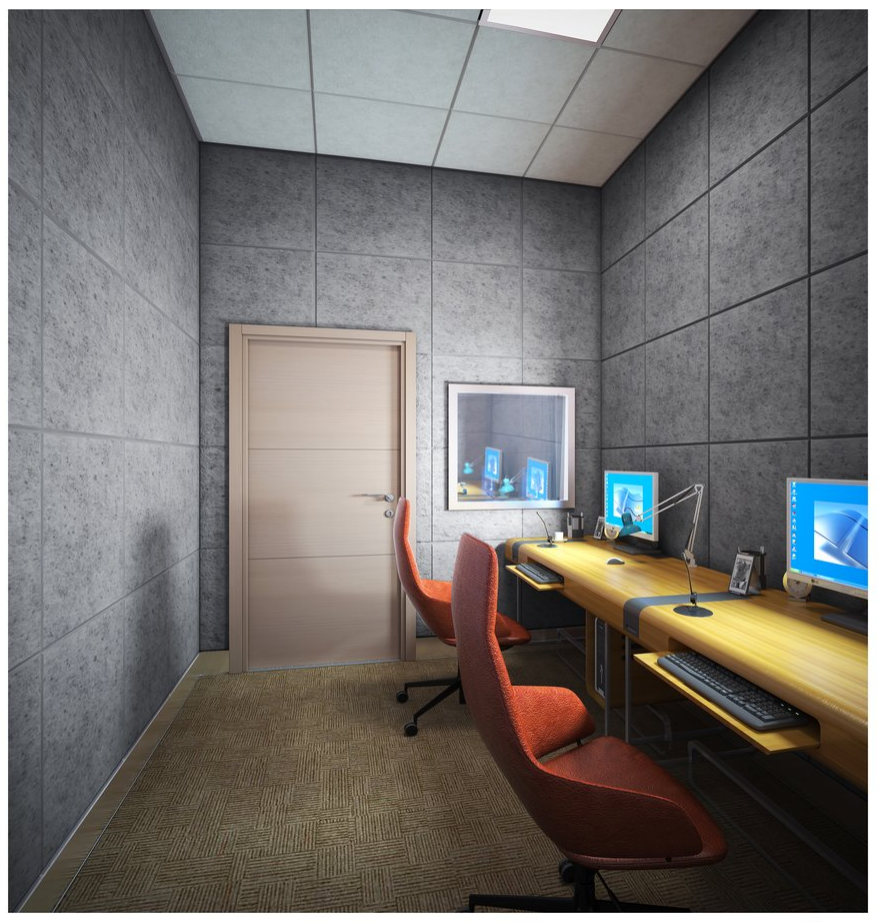
There is no single best value. Approximately 0.2–0.4 seconds can be an initial discussion range for small speech-focused rooms, but room volume, microphone distance, production format, and frequency-dependent decay should determine the final brief.
Not by themselves. Panels mainly control internal reflections. Soundproofing depends on the complete enclosure, including walls, doors, glazing, ventilation routes, seals, and structural transmission paths.
Yes, but limited space can complicate microphone positioning, low-frequency control, treatment depth, and ventilation. Test the proposed layout before committing to permanent construction or visually dominant equipment.
Neither type is automatically better for every studio. Compare pickup pattern, placement, tonal character, operating requirements, and presenter behavior. Evaluate actual recordings rather than relying only on microphone category.
No. Noise reduction may help with some unwanted sounds, but it does not provide building isolation or eliminate every reflection. Evaluate it with quiet speech, laughter, overlapping speakers, and changing background noise.
Combine documented acoustic measurements with a full production rehearsal. Run normal cooling, lighting, computers, displays, and microphones. Check the audience-facing output as well as the untreated recording.
Send Guangzhou Saijia Acoustic & Lighting Engineering Co., Ltd. your floor plan, room dimensions, site location, production format, equipment list, and examples of existing noise.
Request a coordinated acoustic and AV assessment covering isolation, room treatment, cooling, microphone strategy, commissioning, and maintenance. Whether the project is a compact presenter studio or an XR production facility, begin with a measurable brief—not a shopping list of panels.
1. Guangzhou Saijia Acoustic & Lighting Engineering Co., Ltd. — Company profile and published project summaries, including Huzhou radio-broadcast renovation and Qujing television-studio upgrade. Source for company-reported experience, service scope, and project descriptions; not independent verification of certification or acoustic outcomes. [acousticscn]
2. European Broadcasting Union — *EBU Tech 3276, Second Edition, May 1998: Listening Conditions for the Assessment of Sound Programme Material—Monophonic and Two-Channel Stereophonic*. Source for the stated critical-listening reverberation range, noise criteria, and distinction between direct sound, early reflections, and reverberation. Its scope is not a universal live-streaming capture-room standard. [tech.ebu]
3. Shure — *Sounding Out Home Studio Acoustics*, January 25, 2021. Includes commentary from acoustician Nick Whitaker and composer Brian Crosby. Source for room coloration, frequency-dependent treatment, microphone-room context, and the value of acoustic testing. [shure]
4. International Organization for Standardization — *ISO 3382-2:2008: Acoustics—Measurement of Room Acoustic Parameters—Part 2: Reverberation Time in Ordinary Rooms*. Source for the measurement standard's scope, procedures, apparatus, positions, and reporting requirements. [iso]
5. International Organization for Standardization — *ISO 3382-1:2009: Acoustics—Measurement of Room Acoustic Parameters—Part 1: Performance Spaces*. Supplementary reference distinguishing performance-space measurement from ordinary-room reverberation measurement. [iso]