
Views: 228 Author: SJAVL Publish Time: 2026-11-16 Origin: Site


Content Menu
● Fixed Acoustic Treatment vs Variable Acoustics for Multi-Use Auditoriums: The Core Difference
● How Fixed Acoustic Treatment Supports Auditorium Performance
>> Absorption, diffusion, and reflection serve different purposes
>> When fixed treatment is the practical choice
● How Variable Acoustics Changes a Multi-Purpose Hall
>> Retractable curtains and acoustic banners
>> Rotating panels and adjustable reflectors
>> Electronic acoustic enhancement
● Choosing Acoustic Targets: Look Beyond One Reverberation Number
● Start With an Event-Mode Matrix
● Three Overlooked Decisions That Shape Long-Term Value
>> 1. Specify useful adjustability—not just moving hardware
>> 2. Coordinate acoustics with lighting, rigging, and AV
>> 3. Design presets around operators
● Fixed vs Variable Acoustics: Compare Lifecycle Cost
● A Practical Acoustic Commissioning and Handover Plan
● Plan Your Auditorium With SJAVL
>> 1. Is variable acoustics always better than fixed treatment?
>> 2. Can acoustic curtains replace permanent auditorium treatment?
>> 3. What reverberation time should a multi-use auditorium target?
>> 4. Is electronic enhancement the same as physical variable acoustics?
>> 5. Can an existing auditorium receive variable acoustics?
>> 6. What should owners request before accepting the installation?
At Guangzhou Saijia Acoustic & Lighting Engineering Co., Ltd. (SJAVL), we approach fixed acoustic treatment vs variable acoustics for multi-use auditoriums as an operational decision—not simply a choice of wall panels. Our company provides turnkey venue engineering services, connecting acoustic design with construction, professional audio, lighting, stage machinery, LED displays, intelligent controls, and long-term support. Our company profile describes 26 years of experience serving venue owners and operators.
An auditorium may host a morning conference, an afternoon rehearsal, and an evening concert. Those events do not necessarily need the same acoustic environment. Speech benefits from clarity; unamplified music also needs supportive reflections and an appropriate reverberant response.
Our recommendation is to establish a reliable fixed acoustic foundation first, then add adjustability where the event schedule justifies it. The right solution is the one your team can operate consistently—not the one with the most moving parts.
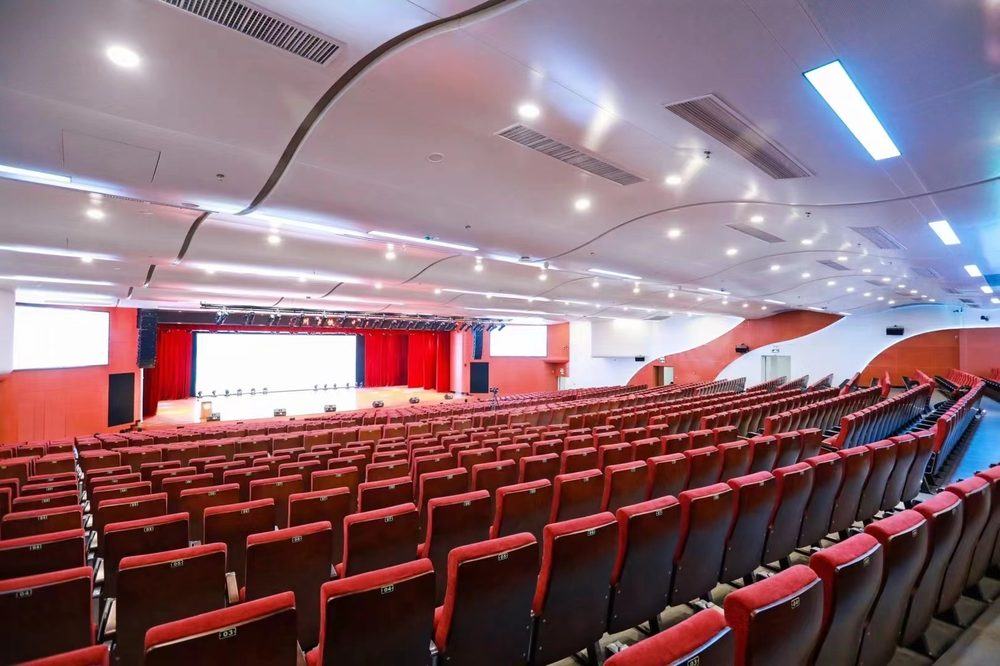
Fixed acoustic treatment permanently shapes a room's sound. Variable acoustics allows selected acoustic characteristics to change between operating modes. Physical variable systems include movable absorption, rotating panels, adjustable reflectors, and coupled reverberation spaces. Electronic acoustic enhancement is another approach, using microphones, processing, and distributed loudspeakers.
| Decision factor | Fixed acoustic treatment | Physical variable acoustics |
|---|---|---|
| Main function | Establishes the room's baseline response | Changes absorption, reflection, or acoustic coupling |
| Typical elements | Absorbers, diffusers, fixed reflectors | Curtains, banners, rotating panels, movable reflectors |
| Operational demand | No acoustic changeover required | Manual adjustment or controlled presets |
| Strongest application | Consistent, clearly defined programming | Events with meaningfully different acoustic needs |
| Main limitation | Limited adaptability after installation | Additional coordination, maintenance, and verification |
These are complementary strategies. A variable system still depends on room geometry, background noise control, suitable materials, and a well-designed baseline.
Absorptive finishes reduce reflected sound energy. Diffusive surfaces redistribute reflections. Reflectors direct useful sound toward listeners or performers.
A successful design balances these functions rather than covering every available surface with absorption. Excessive or poorly located absorption can remove useful musical support without resolving the room's underlying reflection problems.
For example, a speech-led auditorium may need controlled late reflections while retaining helpful early reflections. A music venue may need a more sustained response without distinct echoes. These requirements depend on geometry, volume, seating, and intended use.
Fixed treatment deserves priority when:
- Lectures, presentations, or amplified events dominate the calendar.
- Event requirements are broadly consistent.
- Operators need a straightforward room configuration.
- Retrofit space or maintenance access is restricted.
Our design principle is simple: do not introduce adjustable equipment unless it addresses a defined performance requirement. Complexity should earn its place in the project.
Deployable curtains and banners introduce additional absorption. Retracting them exposes the underlying room surfaces and can restore a more reverberant condition. This is a common strategy for switching between speech-oriented and music-oriented operation.
However, the specification must describe the complete installation—not merely the fabric. Coverage area, mounting arrangement, backing conditions, and frequency-dependent performance all belong in the design brief.
A curtain specification without an installation detail is not a complete acoustic specification.
Rotating panels can expose different surface characteristics. Adjustable reflectors can change the distribution of early sound, including the reflections that help musicians hear one another.
These functions should not be confused. Changing absorption affects decay; moving a reflector also changes where and when reflected sound arrives. Published performance-hall research illustrates how movable ceiling elements can influence both reverberation and stage support.
Electronic enhancement uses microphones, processing, and loudspeakers to modify the perceived acoustic response. It can offer rapid preset changes and additional reverberant support.
It is not a substitute for correcting intrusive noise, poor sound isolation, or an unsuitable baseline. A common design approach starts with a controlled natural acoustic and adds electronic support when required, rather than expecting the system to remove excessive natural reverberation.
Reverberation time describes how sound decays, but it does not fully describe listening quality. Performance-space assessment also considers early decay, clarity, sound strength, and the distribution of reflections. ISO 3382 addresses room-acoustic measurement methods; it should not be treated as a universal prescription for one "correct" auditorium setting.
For speech, the Speech Transmission Index, or STI, evaluates potential intelligibility through an acoustic or electroacoustic transmission path. IEC 60268-16 defines the STI model and associated measurement and prediction methods.
A useful performance brief therefore addresses:
- Reverberation across relevant frequency bands.
- Speech intelligibility under defined operating conditions.
- Music clarity and useful early reflections.
- Background noise and sound-system coverage.
- Differences between audience areas and stage positions.
Avoid accepting a proposal that promises an ideal reverberation time without stating room use, occupancy, measurement conditions, or the locations assessed.
From an EPC planning perspective, the most useful first document is often an event-mode matrix—not an equipment list.
| Event mode | Primary listening priority | Acoustic strategy to investigate |
|---|---|---|
| Conference or lecture | Understandable speech | Controlled decay and coordinated sound reinforcement |
| Drama | Clear dialogue with suitable support | Balanced reflections and adjustable absorption |
| Amplified performance | Controlled room contribution | Appropriate absorption and loudspeaker design |
| Unamplified ensemble | Musical support and blend | Reflective support with absorption reduced where appropriate |
These are starting points, not guaranteed settings. The final configuration must follow project-specific analysis.
Ask the owner to identify event frequency, attendance range, changeover time, and staffing. A prestigious annual concert should be considered, but so should the hundreds of routine events that keep the building operating.
An empty rehearsal and a full performance can produce different acoustic conditions. Research on auditorium seating shows that chair construction and occupancy influence absorption. Therefore, an empty-room demonstration alone cannot establish every occupied-room outcome.
Define seating assumptions early. Where direct occupied testing is impractical, document how the design accounts for audience absorption and what uncertainty remains.
"Motorized acoustic curtains included" does not describe an acoustic outcome.
Our recommended brief identifies:
- The event modes the system must support.
- The frequency-dependent response expected in each mode.
- The permitted changeover process.
- The measurement and acceptance procedure.
- The operating limitations disclosed to the owner.
This turns adjustability into a testable requirement. It also prevents a visually impressive installation from being mistaken for verified acoustic flexibility.
Variable acoustic elements occupy the same building volume as lighting fixtures, loudspeakers, screens, stage machinery, and maintenance routes.
SJAVL's published service scope brings these disciplines together within venue engineering. For an integrated project, the design should examine their interfaces before procurement and installation—not after equipment arrives on site.
We recommend coordinated drawings that show movement envelopes, access requirements, structural interfaces, and operating sequences.
A technically capable system provides limited value if staff cannot select the correct configuration.
Use clear names such as "Conference," "Drama," and "Acoustic Music." Document what each preset changes and what still requires inspection.
For mechanically operated systems, the operating procedure should also address authorization, safe sequencing, and fault response. The exact requirements must be established with the relevant equipment specialists and applicable local rules.
Purchase price is only one part of the decision. For procurement, we recommend comparing the complete ownership burden:
1. Design, modelling, and coordination.
2. Materials, mechanisms, and controls.
3. Structural and installation interfaces.
4. Commissioning and staff training.
5. Inspection, cleaning, and replacement access.
6. Spare parts and service availability.
7. Operational disruption during maintenance.
For cross-border projects, also define responsibility for local installation, remote support, warranty procedures, and documentation.
There is no credible universal price premium or payback period for variable auditorium acoustics. Request an itemized, project-specific comparison rather than a percentage unsupported by the actual scope.
Commissioning should demonstrate the agreed operating modes, not simply confirm that motors and loudspeakers turn on.
We recommend the following sequence:
1. Confirm installed materials and mechanical configurations against approved documents.
2. Record the room condition, seating arrangement, occupancy, and building-services operation.
3. Measure relevant room-acoustic parameters at agreed source and receiver positions.
4. Assess speech transmission where required by the brief.
5. Repeat the agreed tests for each acoustic mode.
6. Conduct listening checks with representative programme material.
7. Deliver configuration records, operating instructions, and maintenance requirements.
ISO 3382 provides a measurement framework for room acoustics, while IEC 60268-16 addresses STI methods. Acceptance criteria, test conditions, and contractual responsibilities must still be specified for the individual project.
At Guangzhou Saijia Acoustic & Lighting Engineering Co., Ltd., our service scope connects acoustic engineering with professional audio, lighting, stage machinery, LED displays, intelligent control, installation, testing, and ongoing support.
For your next auditorium project, send SJAVL the room drawings, seating capacity, event schedule, existing equipment information, budget parameters, and project location.
Ask for a comparison of fixed, variable, and hybrid acoustic strategies—including operating modes, multidisciplinary interfaces, commissioning requirements, and lifecycle responsibilities. The objective is a venue that performs as intended and remains manageable after handover.
No. Fixed treatment can be appropriate when the venue's activities have consistent acoustic requirements. Variable systems become useful when different events need meaningfully different room responses. The decision should follow the programme brief rather than a preference for additional technology. [akaacoustics]
Not comprehensively. Curtains provide adjustable absorption, but auditorium design also involves reflection control, room geometry, noise, seating, and sound-system integration. Their contribution must be evaluated as part of the complete room. [akaacoustics]
There is no single correct value. Appropriate targets depend on room volume, event type, occupancy, geometry, and whether sound reinforcement is used. Specify mode-specific objectives rather than adopting an unexplained universal number. [akaacoustics]
No. Physical systems change architectural conditions, such as exposed absorption or reflector position. Electronic enhancement uses microphones, processing, and loudspeakers to modify the acoustic experience. Both require an appropriate underlying room design. [l-acoustics]
Potentially. Begin with a survey of the current acoustic response, available installation space, structure, access, and operating needs. Retrofit measures may include curtains, banners, or other adjustable elements, but feasibility and achievable performance are project-specific. [akaacoustics]
Request documented test conditions, agreed acoustic measurements, mode settings, operating instructions, and maintenance information. Room-acoustic and speech-transmission testing should use suitable methods, with acceptance requirements defined in the project brief. [iso]
- SJAVL, "Saijia Acoustic: China Acoustic Engineering & Studio Design Company." Source for the company description, stated experience, EPC services, and technical scope. These are company-published claims, not independent certification verification. [acousticscn]
- International Organization for Standardization, "ISO/DIS 3382-1: Acoustics—Measurement of room acoustic parameters." Source for the scope of performance-space acoustic measurements; this listing concerns a draft revision, so the applicable published edition should be confirmed in project contracts. [iso]
- International Electrotechnical Commission, "IEC 60268-16:2020—Sound system equipment—Part 16: Objective rating of speech intelligibility by speech transmission index." Source for STI definitions and measurement scope. [cdn.standards.iteh]
- L-Acoustics, "What are Active Acoustics and Variable Acoustics?" Published November 18, 2024. Source for the distinction between physical variability and electronic enhancement. [l-acoustics]
- "Variable Control of the Room Response in Performance Venues," Auditorium Acoustics Hamburg 2018 proceedings. Source for movable acoustic elements, stage reflections, and electronic-enhancement design considerations. [akutek]
- "Acoustic characterisation of chair absorption and simple methods for …," *Building and Environment*, 2024. Source for the influence of seating construction and occupancy on absorption. [sciencedirect]
- "Variable Acoustics in Performance Venues—A Review." Source for variable absorption, adjustable architectural elements, and coupled reverberation spaces. [e-sciencecentral]
- Theatre Acoustics, "Variable Acoustics." Source for contrasting architectural and electronically enhanced design approaches. [ta-inc]
Hot Tags: China, Global, OEM, private label, manufacturers, factory, suppliers, manufacturing company