Language


Views: 218 Author: Saijia Acoustic Publish Time: 2026-11-05 Origin: Site


Guangdong Han Opera is a national-level item of intangible cultural heritage, and the Guangdong Han Opera Theatre is responsible for preserving and passing on this art form. In 2008, a lighting and sound equipment procurement and audio, lighting and AV systems integration project worth RMB 7.1817 million was completed in Meizhou. The project covered two venues—the main theatre and the rehearsal hall—and integrated three major systems: architectural acoustics and interior treatment, stage lighting, and stage sound. It ran from the award of the contract on March 10, 2008, and contract signing on April 18, to successful acceptance by all five parties on October 11, taking approximately six months. Drawing on the award notice, completion acceptance findings and photographs of the finished venues, this article reconstructs the full story of the theatre's audio, lighting and AV integration project. It also offers readers interested in acoustic design for traditional opera theatres, stage lighting and sound engineering, and theatre acceptance standards a real-world reference from seventeen years ago. (Keywords: theatre audio, lighting and AV systems integration | acoustic design for traditional opera theatres | stage lighting and sound engineering | Guangdong Han Opera Theatre | theatre acceptance standards)
On March 10, 2008, Guangdong Yuanzheng Tendering & Procurement Co., Ltd., acting on behalf of the Guangdong Han Opera Theatre, organized the tender for the theatre's lighting and sound equipment procurement project (Tender No. YZMZ08HJ001HG001). Following a rigorous review and recommendation by the evaluation committee, the purchaser selected Guangzhou Saijia Acoustics & Lighting Engineering Co., Ltd. as the successful bidder. The two parties formally signed the contract on April 18, 2008. The key project details are as follows:
Project Element | Details |
Project Name | Guangdong Han Opera Theatre Lighting and Sound Equipment Procurement Project (Main Theatre and Rehearsal Hall Audio, Lighting and AV Systems Integration Project) |
Purchaser | Guangdong Han Opera Theatre (the institution responsible for preserving and passing on the national intangible cultural heritage of Guangdong Han Opera) |
Tendering Agent | Meizhou Branch of Guangdong Yuanzheng Tendering & Procurement Co., Ltd. |
Contract Award / Signing | Awarded on March 10, 2008; contract signed on April 18, 2008 |
Project Location | Meizhou, Guangdong Province (a key municipal project in Meizhou) |
Project Venues | Main theatre and rehearsal hall (integrated delivery across two venues) |
Scope of Work | Architectural acoustic treatment + stage lighting system + stage sound system integration + rehearsal hall supporting facilities |
Contractor | Guangzhou Saijia Acoustics & Lighting Engineering Co., Ltd. (Class I architectural acoustics qualification; certified as a high-tech enterprise) |
The vocal style of Han Opera combines powerful projection with delicate expression, creating particular requirements for room reverberation time and early reflections. The design was developed with reference to GB/T 50356, the Code for Architectural Acoustics Design of Theatres, Cinemas and Multipurpose Halls. On the one hand, sound-insulating constructions were used to block external traffic and equipment noise and reduce background noise levels. On the other, sound absorption and diffusion were applied to control reverberation time precisely and address acoustic defects such as echoes, flutter echoes and sound focusing. The balance of absorption and diffusion was tailored to achieve "clear singing and full, rich musical sound": avoiding an overly absorptive, dry acoustic while also preventing excessive reverberation from making the sound muddy. The aim was to keep lyrics intelligible, musical sound warm and full, and coverage even across the audience seating.
To meet the complex lighting requirements of traditional opera—including front, top, side and followspot lighting—the design established a multi-layer lighting scheme equipped with professional stage fixtures, a lighting console and a control system. Carefully planned fixture positions and dimming circuits enable precise shaping of performers and stage atmosphere. Lighting thus becomes part of the storytelling while meeting Han Opera's demanding requirements for visual depth and faithful color rendering.
The sound reinforcement system was designed with reference to GB 50371, the Code for Design of Sound Reinforcement Systems in Halls. Appropriate loudspeaker placement and power configuration were used to provide even coverage throughout the audience area, avoiding excessively loud local areas and acoustic dead zones. The system was also designed for high fidelity and low distortion, faithfully reproducing Han Opera's music and sound effects while balancing speech intelligibility with musical richness.
The rehearsal hall is essential for refining productions and supporting performers' daily training. Its acoustic environment was designed to simulate that of the performance stage as closely as possible, giving performers listening feedback similar to what they would experience during a show and reducing the gap between rehearsal and live performance. Lighting and sound equipment suited to rehearsal use was also provided, allowing directors and performers to adjust lighting effects and sound in real time.
As a key municipal project in Meizhou, the work was subject to strict requirements for quality, schedule and acceptance. Before work began, the project team reviewed the major challenges one by one and developed corresponding measures, resolving potential issues before mobilization.
Differences between actual site conditions and design drawings can easily lead to unclear construction boundaries and discrepancies in quantities. Before construction, the project team checked the drawings and schedules item by item against actual site conditions. Where discrepancies were found, changes were confirmed in advance, and construction proceeded in accordance with the approved drawings and schedules. This helped prevent disputes and rework at the source.
The project involved specialist stage machinery systems, where coordination of work sequences and alignment of technical standards with the equipment supplier could otherwise lead to inconsistencies. The project team held technical coordination meetings with the stage machinery contractor in advance, clarified each party's scope of work, interface standards and key milestones, and assigned dedicated personnel to coordinate technical issues during construction to ensure smooth cooperation across disciplines.
Newly constructed areas had relatively high moisture levels, which could damage completed finishes and electromechanical equipment. The project team prepared a dedicated moisture-control and finished-work protection plan in advance. Ventilation, dehumidification and other measures were used in new areas. For later renovation work, a phased protection plan was adopted, with completed finishes and equipment fully covered by protective film and temporary protective boards.
The opera face patterns on the rehearsal hall walls were a specialized artistic feature requiring accurate reproduction and precise painting—results that a general construction crew might not be able to guarantee. The project therefore engaged a professional art instructor from an academy of fine arts to paint the wall patterns, incorporating the artistic finish into the project's quality management.
The main theatre is the principal public showcase for Han Opera. During construction, three acoustic treatments were implemented in accordance with the detailed design. Sound-insulating construction blocked external noise and reduced background noise; sound-absorbing construction controlled reverberation time; and sound-diffusing construction addressed echoes, flutter echoes and sound focusing. The ceiling and side walls had to accommodate both acoustic treatments and the installation requirements of stage fixtures and rigging systems. Their positions were therefore coordinated during detailed design to prevent conflicts.
Construction of the solid-wood stage floor was highly sensitive to environmental conditions. High ambient humidity could cause the timber to expand, contract or warp, making joint treatment difficult. Site humidity was monitored before installation, and dehumidification measures were taken to keep conditions within the specified range. After the flooring was laid, the joints were treated using a hand-applied finishing process to maintain a level surface and good sealing, reduce the risk of moisture-related deformation and extend the floor's service life.
The stage lighting system was installed and commissioned according to the multi-layer lighting scheme, including the fixtures, lighting console and control system, enabling rapid scene changes and layered lighting effects. The stage sound system underwent loudspeaker placement, power configuration and system commissioning to achieve even audience-area coverage, high fidelity and low distortion. Installation and commissioning proceeded alongside the acoustic works. Rigging, cable routes and load requirements were coordinated in advance in the detailed drawings to reduce on-site rework.
The rehearsal hall received acoustic treatment and supporting lighting and sound equipment to a standard intended to make it "close to the performance stage." Professional art instructors painted the opera face patterns directly onto the walls, achieving the required fidelity and artistic effect. The rehearsal space itself thus became a showcase for Han Opera culture.

▲ Rehearsal hall: Han Opera face patterns on the wall integrated with the acoustic finishes
Protection of completed work was maintained throughout the project—from acoustic surface finishes and lighting and sound equipment to the solid-wood floor and face-pattern wall. Protective film and boards were applied comprehensively, with phased handovers and room-by-room protection to prevent damage from overlapping trades and moisture. The quality of a major project is often reflected in these details that are easy to overlook.
On October 11, 2008, an acceptance meeting was held for the sound and lighting works at the Guangdong Han Opera Theatre in the Hakka Arts Center. Representatives of five parties attended: the project owner, the supervising entity, the contractor, the Meizhou Dongshan Education Base Project Construction Working Group, and the design entity. The completion acceptance findings were as follows:
Building works: Compliant with the design requirements and relevant national standards. Testing by a professional institution confirmed that all indicators met the design requirements and applicable national provisions; the works passed acceptance.
Acoustics: Compliant with the design requirements and relevant national standards. Testing by a professional institution confirmed that all indicators met the design requirements and applicable national provisions; the works passed acceptance.
Expert opinions: Approval was given for the sound reinforcement system to pass acceptance, and approval was also given for the lighting system to pass acceptance.
From contract signing on April 18, 2008, to acceptance on October 11, the project took approximately 180 days to deliver integrated systems across two venues and three major disciplines.
The design, construction and acceptance of this project referred to the following national and industry standards:
Standard No. | Standard Title | Application in This Project |
GB/T 50356 | Code for Architectural Acoustics Design of Theatres, Cinemas and Multipurpose Halls | Main theatre room-acoustics design, reverberation time and sound-field control |
GB 50118 | Code for Design of Sound Insulation of Civil Buildings | Sound-insulating constructions and background-noise control |
GB 50371 | Code for Design of Sound Reinforcement Systems in Halls | Stage sound reinforcement and sound-field performance indicators |
GB/T 28049 | Code for Design of Sound Reinforcement Systems in Halls and Sports Venues | General sound reinforcement system design |
GB/T 4959 | Measurement Methods for Sound Reinforcement Characteristics of Halls | Post-construction acoustic/sound reinforcement testing and acceptance |
GY 5067 | Relevant Industry Standards for Stage Lighting Design | Stage lighting arrangement and dimming systems |
GY/T 5086 | Relevant Industry Standards for Hall Acoustics | Reference for acoustic treatment in traditional opera theatres |
JGJ 57 | Code for Design of Theatre Buildings | Reference for coordination of theatre architecture, acoustics and lighting |
The acceptance conclusion that "testing by a professional institution confirmed that all indicators met the design requirements and applicable national provisions" provides third-party verification in line with the standards listed above.
After passing acceptance, the main theatre was quickly put into use. From September 2008, its stage lighting and sound systems were put to practical use in performances and major conferences. Over the following decade and more, the venue served both as a base for preserving and promoting Guangdong Han Opera and as a cultural hub for major meetings and artistic performances in Meizhou. The following photographs show the completed project.

▲ Main theatre auditorium: Integrated acoustic finishes, lighting and sound systems across the stalls and balcony
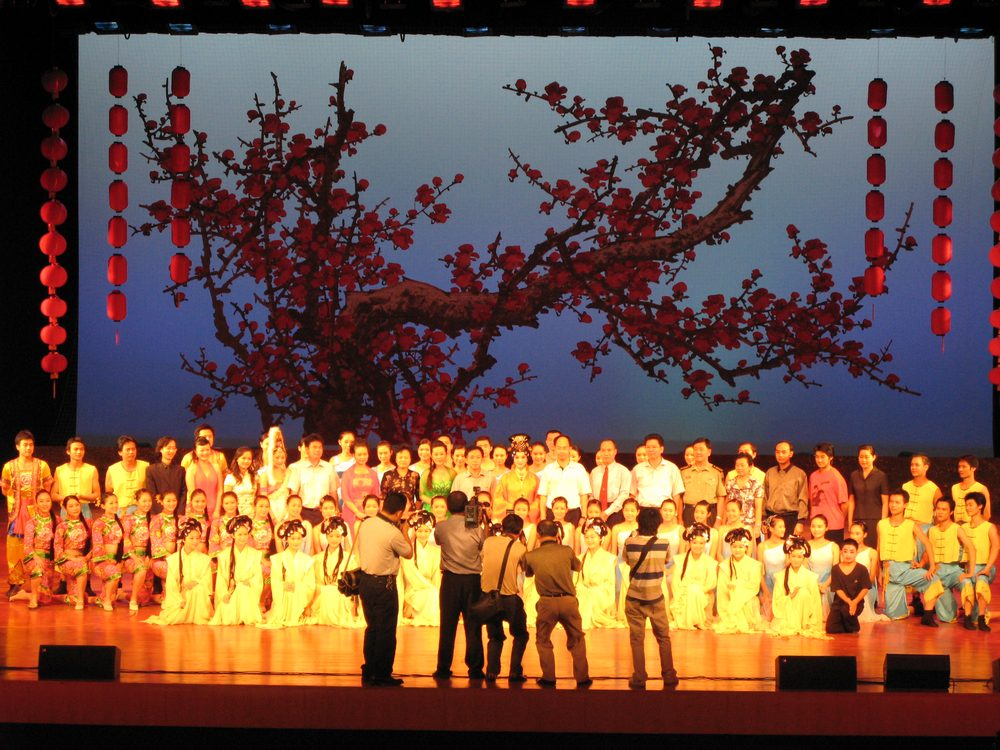
▲ Main theatre in operation: Leaders and cast members pose on stage after a performance (September 2008)
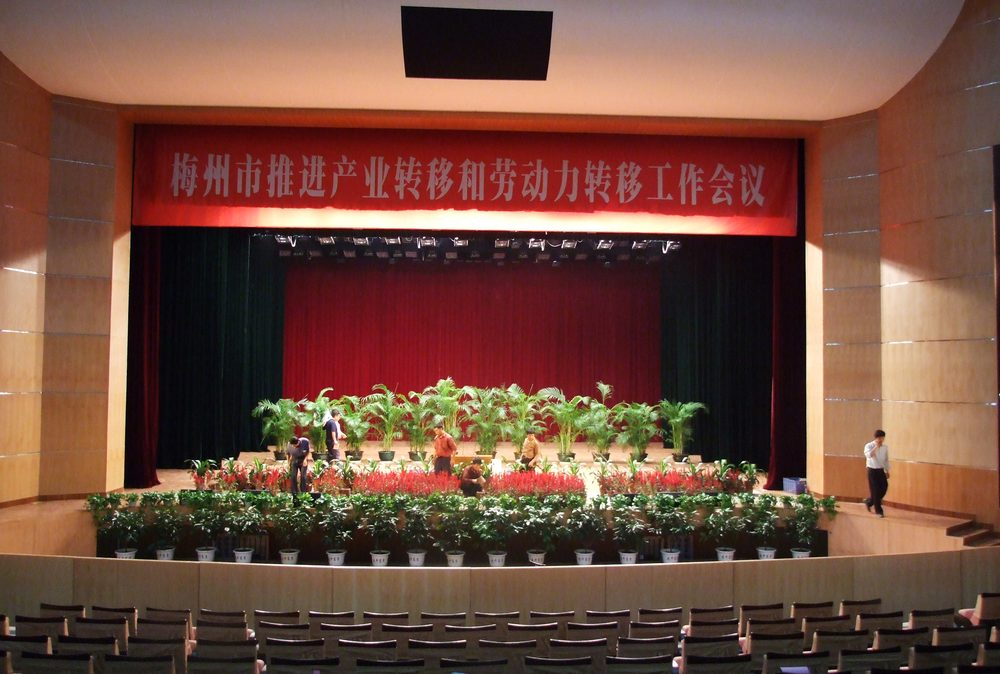
▲ Main theatre hosting a citywide conference: Stage sound reinforcement and lighting systems put to practical use
From its successful acceptance in 2008 to the present, the main theatre and rehearsal hall have continued to support the preservation and performance of Guangdong Han Opera and the cultural life of Meizhou. The demanding requirements of opera performances for vocal clarity and musical richness, major conferences for clear speech reinforcement, and daily rehearsals for consistent acoustics have all been tested over the long term across these two venues. For the contractor, Guangzhou Saijia Acoustics & Lighting Engineering Co., Ltd., the project represents a comprehensive demonstration of its audio, lighting and AV systems integration capabilities, as well as a representative modernization project for a cultural heritage venue.
Q: Which spaces and systems were included in the Guangdong Han Opera Theatre project?
A: The project covered the theatre's two key spaces—the main theatre and the rehearsal hall. The scope included architectural acoustic treatment, procurement and installation of the stage lighting system, integration of the stage sound system, and supporting lighting and sound equipment for the rehearsal hall. Together, these formed a one-stop solution covering two venues and the full range of systems.
Q: Why does a traditional opera theatre need dedicated acoustic treatment?
A: Traditional opera places high demands on the balance between vocal clarity and musical richness. Sound insulation, absorption and diffusion are used to control reverberation time and address acoustic defects such as echoes. These measures help keep lyrics intelligible and musical sound warm and full, providing the technical foundation for presenting the art form effectively.
Q: What is reverberation time, and how does it affect sound quality in a main theatre?
A: Reverberation time is the time required for sound to decay by 60 dB after the sound source stops. If it is too short, the room can sound dry and lack richness; if it is too long, speech becomes indistinct and echoes become noticeable. A traditional opera theatre needs an appropriate reverberation-time range to balance lyric intelligibility and musical atmosphere.
Q: What lighting requirements must stage lighting meet for traditional opera?
A: Traditional opera performances use multiple layers of lighting, including front, top, side and followspot lighting, to shape performers' appearances and create the atmosphere of each scene. This project provided professional stage fixtures, a lighting console and a control system to support rapid scene changes and layered lighting effects.
Q: Why should the rehearsal hall have acoustics close to those of the performance stage?
A: Simulating the performance stage's acoustic environment gives performers listening feedback similar to what they will experience during a show and helps prevent them from feeling unfamiliar with the sound when they step onto the stage. This supports rehearsal efficiency and performance quality and is an important part of refining a production.
Q: What should be checked when accepting a theatre audio, lighting and AV project?
A: In this project, acceptance covered two areas: building works and acoustics. Both had to meet the design requirements and relevant national standards. A professional institution tested the acoustic and sound reinforcement indicators; experts separately issued approval opinions for the sound reinforcement and lighting systems. Final confirmation was signed by representatives of the five parties: the owner, supervising entity, contractor, project construction working group and design entity.
1. Prioritizing decoration over acoustics: Focusing only on visual appearance while neglecting sound insulation and reverberation control can leave a theatre noisy and lyrics indistinct, preventing even high-end lighting and sound systems from performing to their potential.
2. Leaving reverberation uncontrolled: Without sound absorption and diffusion, excessive reverberation can make vocals and music muddy and cause obvious echoes, compromising the listening experience of traditional opera.
3. Treating lighting, sound and acoustic construction as separate disciplines: Conflicts between rigging and cable routes can undermine acoustic performance and limit lighting flexibility, leading to repeated on-site rework.
4. Allowing rehearsal-hall acoustics to differ from the performance stage: Large differences in listening conditions can leave performers unprepared when they go on stage and affect performance quality.
5. Relying on thick walls while neglecting construction sealing: Sound leaks can undermine the effectiveness of sound insulation and allow external noise to disturb the theatre.
6. Ignoring acoustic defects: Failure to address echoes, flutter echoes and sound focusing can result in poor listening conditions in some seats and diminish the audience experience.
7. Skipping post-construction acoustic testing: Without measuring reverberation and sound insulation, problems may only emerge after the venue enters service, when rectification is difficult and can disrupt performances. The professional testing and confirmation that all indicators met requirements in this project provide a useful reference.
Guangzhou Saijia Acoustics & Lighting Engineering Co., Ltd. undertakes acoustic fit-out and integrated audio, lighting and AV systems projects in auditoriums, theatres, studios, concert halls, recording studios, sports venues and other spaces in China and overseas. Its primary service area is South China—including Guangzhou, Meizhou, Foshan, Shenzhen, Dongguan, Zhuhai, Zhongshan, Huizhou and cities throughout the Guangdong–Hong Kong–Macao Greater Bay Area—with services also extending to East, Central and Southwest China. Free on-site surveys and solution comparisons are available for complete theatre construction, professional rehearsal rooms and studios, modernization of cultural heritage venues, and integrated audio, lighting and AV projects for multipurpose halls.
Customer Service Hotline: +86 20 8629 9208
Company Address: Room 615, Building 3, No. 135 Huangyuan Road, Baiyun District, Guangzhou, Guangdong, China
Key Services and Keywords: theatre audio, lighting and AV systems integration | acoustic design for traditional opera theatres | stage lighting and sound engineering | modernization of cultural heritage venues | theatre acceptance standards | rehearsal hall acoustic design