
Views: 219 Author: Saijia Acoustic Publish Time: 2026-11-26 Origin: Site


Content Menu
● 2. Cultural Roots and What Must Be Preserved
● 3. The Immersive Gene Already Present in the Form
● 4. Space Meets Technology: An Architectural and Engineering Layer
>> What the delivery covers for this production
● 5. Multi-Sensory Design: How Technology Reinforces the Cultural Core
● 6. Breaking the Fourth Wall: From Spectators to Co-Travellers
● 7. How Saijia Delivers This Production
● 8. Technical Baseline and Specification Map
>> Cultural element to technology mapping
● 9. Commercial Viability and the Guest Journey
● 10. Frequently Asked Questions
● 11. Pitfalls to Avoid (Producer & Designer Guide)
● 12. Cultural Respect, Risks and Guardrails
Published in Industry Insights & Trends · the Levant and the Arab Middle East
Topic: Levantine Hakawati storytelling and narrative poetry · Country/region: Lebanon, Syria, Jordan, Palestine and the Levant · Written for venue owners, producers and engineering teams.
The hakawati was the public narrator of Arab cities and caravan stops, holding court in coffeehouses and souks through long evenings and reciting episodes from The Thousand and One Nights, Bedouin epics and local chronicles to the accompaniment of a single-string rababa, a drum and vocal gesture. The form is oral, communal and episodic — one thread branches into another and the pace follows the crowd — so it was already an environmental occasion rather than a proscenium show. What follows is a design proposal for staging that form with branching narrative in an immersive venue: a new production, not a restaging of an existing performance, with repertoire, casting and script commissioned locally.
This article is written from the perspective of Guangzhou Saijia Acoustic & Lighting Engineering Co., Ltd. (SJAVL), a turnkey venue-engineering partner that designs and delivers immersive theatres, XR studios, concert halls and multi-purpose venues across international markets. It moves from the cultural roots of the form to spatial design, multi-sensory engineering, the fourth wall, the systems a turnkey team can deliver, commercial realism, and the guardrails that keep a tradition authentic once it enters a contemporary entertainment space.
Written by the SJAVL editorial team, with acoustic, lighting and stage-engineering review before publication. Guangzhou Saijia Acoustic & Lighting Engineering Co., Ltd. (SJAVL) is founded in April 2000, 26 years of venue-engineering practice.
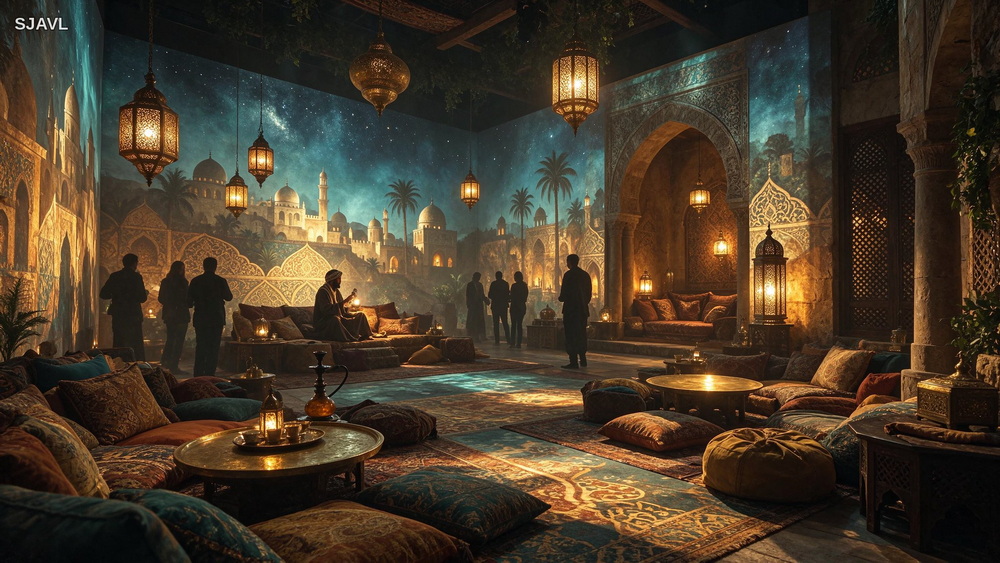
How to read this article. The specification table in section 8 holds planning baselines for discussion, not measurements taken from a built room. The rendering shown below is a concept illustration produced for this article, not a photograph of a completed Saijia project. Any real project begins with site survey, local cultural review and a bespoke brief.
The hakawati was the public narrator of Arab cities and caravan stops, holding court in coffeehouses and souks through long evenings. Reciting episodes from The Thousand and One Nights, Bedouin epics and local chronicles, he accompanied the tale with a single-string rababa, a drum and vocal gesture, holding listeners through suspense, repetition and formulaic openings. The form is oral, communal and deeply episodic: one thread branches into another, and the pace depends on the crowd's reaction. In its warm coffee-and-coffeehouse air, tiled benches and hanging lamps, it is already an environmental, immersive occasion rather than a proscenium show.
An immersive adaptation rebuilds the coffeehouse as a network of small chambers, each holding one story strand. The hakawati remains the guide at a central hearth; guests choose doors that follow different nights of Scheherazade's tale or a local epic, returning to compare threads. Branching choices are modest and reversible so the oral narrative survives. The rababa and live voice stay central; projections supply desert, palace and night-sky scenery behind them, never replacing the narrator's physical presence.
An immersive production begins with the room, not with a projector or a speaker. For Levantine Hakawati storytelling and narrative poetry, the first engineering decision is whether to retain an existing hall, adapt a non-theatre building, or build a purpose-made shell, and how each choice changes the way guests move, breathe and listen. Plan, surfaces, sightlines and acoustic volume are drawn before any fixture is specified, so that later technology disappears into the architecture instead of hanging on it as what the industry calls “digital wallpaper”.
The spatial concept usually combines a free-roaming zone with one or more anchor stages. In the roaming zone guests choose their own route among scenes, doorways and small enclaves; in the anchor stages a choreographed sequence brings the group together for the emotional turning point of the story. The plan follows a circular hearth with radial chambers and a back corridor for scene changes. Low seating and standing niches let guests rest or move; arches and mashrabiya screens define thresholds without closing sightlines. Wall surfaces combine fabric, wood and tile-look finishes to warm reflections and reduce harsh slap-back. Service passages run behind the chambers so crew and equipment remain unseen.
Hearth point-source audio and close miking for the narrator, the rababa and the drum, keeping oral authority central.
Chamber ambient speakers and textile absorption against tiled surfaces, so the coffeehouse stays warm rather than slap-back.
Lantern practicals with a low focal pool at the hearth, dimmed to keep faces and hands visible all evening.
Dim rear-wall mapping in each chamber, with no bright main screen and the projection strictly behind the teller.
One cue timeline across hearth and chambers, with manual override, route signage, concealed wiring and fire-rated textiles.
Acoustic geometry is settled at the same stage. A hall built for intimate tradition-derived storytelling cannot simply be fitted with the loudness and reverberation of a concert arena: surface materials, ceiling height, seating density and the placement of reflective and absorbent finishes are tuned together so that close-range dialogue stays intelligible while surround effects wrap around the room without harshness. Structural isolation separates audience circulation from performance machinery, keeping footsteps, chair movement and ventilation noise out of the quiet moments. Planning for this production starts from room acoustics at RT60 about 0.8-1.0 s; dialogue STI >= 0.62; noise NR-25; absorbent textiles control echo in tiled areas.
The danger facing any tradition reinterpreted through immersive media is that spectacle replaces meaning. Each sensory layer is therefore attached to a specific cultural element rather than to a generic mood preset: the creative and engineering teams first write down what the original form asks the audience to notice — a particular rhythm, a vocal style, a symbolic object, a procession, a moment of silence — and only then choose equipment, so that the technology makes that element clearer rather than louder.
Sound as carrier of tradition. Spatial audio distributes voices, instruments and environmental cues around the room so that a caller, a drummer or a narrator can appear to move among the guests, matching the way many oral and ritual traditions once performed in the round or in open air. Tuned reverberation recreates the acoustic character of the original setting without sacrificing speech intelligibility, close-mic'd voices preserve timbre and dialect, and ambient beds carry the place: wind, crowd, water, fire. Warm low-level light through glass lanterns establishes the coffeehouse evening; a faint coffee-cardamom scent and textile warmth add tactility. Spatial audio lets the narrator's voice occupy the hearth while an unseen chorus and animal calls emerge from chamber doors. The rababa's bowed tone and drum accents are reinforced without equalisation that erases their nasal, plucked character. Projection imagery uses moonlight and sand colours, kept dim enough that faces and hands stay visible. Planning for this production starts from audio at Hearth point source plus chamber ambient speakers; live rababa and drum reinforcement; optional translation headset loop.
Light, image and the body. Lighting separates into three layers — functional light for safe circulation, atmospheric light for mood, and performance light that reveals faces, costumes and symbolic action — with colour temperature, intensity and contrast taken from the palette of the source tradition and dimming curves following the rhythm of the music rather than generic festival flashes. Projection mapping and LED planes carry scenery, pattern and memory but stay restrained around physical set pieces and real performers; where the tradition relies on handcrafted objects, those objects stay physical and tactile. Touch, scent and temperature complete the picture, applied lightly and tested against comfort and allergy constraints, because an overload of stimulation reads as noise rather than immersion.
The “fourth wall” is the invisible proscenium that separates watching from acting. Immersive theatre dissolves it by placing guests inside the narrative rather than opposite it, and Levantine Hakawati storytelling and narrative poetry already contains the seeds of that dissolution in its original practice — through direct address, circular staging, call-and-response, procession, or the audience's acknowledged role in the event. A modern production does not invent this relationship; it restores it at a larger scale, using technology to keep the encounter legible when the room grows.
Guests are offered levels of participation rather than a single forced choice. Some remain observers who walk freely; others accept a small role, carry an object, follow a thread of dialogue, or vote on a branch of the story. Staff and trained performers monitor comfort, so that shy guests are not pulled into action against their will. Guests may ask the narrator to repeat a passage, choose which branch to follow, or step into a small scene as a silent traveller or merchant. The hakawati addresses the room directly as his predecessors did and welcomes calls of recognition. Accessible headset layers carry Arabic-to-English or French translation and background, while the live acoustic room keeps the communal heartbeat of the cafe.
Technology supports that openness without taking over the performance. Real-time control lets performers trigger lighting, sound and visual cues from their positions in the room, and location-aware or branching systems keep the narrative coherent when guests split into different routes. Personal headsets, where used, deliver optional language and inner-monologue layers while the shared room stays audible. The co-creation offered to the guest remains bounded by the integrity of the source tradition: the audience may explore and respond, but symbols, sacred elements and historical meaning stay with the tradition's custodians. The mapping that follows is specific to this form: hearth narrator, rababa and drum → central point-source audio, close miking, warm acoustic finish, focal lighting.
Guangzhou Saijia Acoustic & Lighting Engineering Co., Ltd. (SJAVL) works as a turnkey venue-engineering partner from concept design through construction, supply, installation, commissioning, testing and long-term technical support, covering acoustic decoration, professional lighting and audio, stage machinery and rigging, LED display walls, intelligent control and AV integration, together with XR virtual-extension technology — assembled by one accountable team that balances artistic ambition against buildability, comfort, maintenance and operating cost. For a tradition-derived production in Lebanon, Syria, Jordan, Palestine and the Levant, the delivery scope is set by the form rather than by a fixed package: the five items above in section 4 are the concrete scope for this production, and everything else is agreed only after the site is surveyed. Planning for this production starts from control and safety at One-cue timeline for chambers and hearth; manual override; stable arches; concealed wiring; fire-rated textiles.
Delivery in this market. A Levantine coffeehouse venue is usually a converted hospitality space rather than a purpose-built theatre, so the survey question is what the existing shell can carry: a power position for lanterns and close miking, a stable hearth, a route that lets guests move between chambers, and a service corridor that keeps crew and equipment out of sight. Programming follows the rhythm the form came from — long evenings rather than fixed curtain times, with local regulars, families and visitors sharing the same room — so entry is staggered and the hearth is filled in turns rather than all at once. Sound and light then have to hold an intimate register across rooms of different character: the hearth reads as one close, warm source, while the chambers are quieter and dimmer, which is an acoustics and low-level-lighting problem rather than a loudness contest. Specification closes against the script, the cast and the dialect in use, because the evening is carried by a live voice in a particular city rather than by a fixed recording.
These are planning baselines for discussion, not measurements from a built room. Reverberation targets assume an occupied room at the audience density stated in the capacity row; speech-intelligibility figures assume continuous use with reinforcement in place; background-noise figures assume the room is mechanically isolated from adjacent programmes. Actual values are set after site survey and regulatory review, then confirmed by measurement at handover, and they always follow the standards and codes in force in the country where the venue is built.
| System / parameter | Planning baseline — not a measurement |
|---|---|
| Audience capacity | 90-150 split across hearth and 4-6 story chambers; hearth holds 30-40 |
| Room acoustics | RT60 about 0.8-1.0 s; dialogue STI >= 0.62; noise NR-25; absorbent textiles control echo in tiled areas |
| Lighting | Lantern-style practicals 20-60 lx; hearth focal pool 120 lx; CRI >= 90, 2400-2800 K |
| Projection / display | Dim rear-wall mapping in chambers; no bright main screen; palette matched to night and sand |
| Audio | Hearth point source plus chamber ambient speakers; live rababa and drum reinforcement; optional translation headset loop |
| Control and safety | One-cue timeline for chambers and hearth; manual override; stable arches; concealed wiring; fire-rated textiles |
| Original element | Sensory target | Saijia system and deliverable |
|---|---|---|
| Hearth narrator, rababa and drum | Oral authority, live timbre | Central point-source audio, close miking, warm acoustic finish, focal lighting |
| Branching epic and One Thousand and One Nights | Explorable episodic narrative | Radial chamber set design, chamber-linked projection and control, participant route signage |
| Coffeehouse communal evening | Warm tactile atmosphere | Low-level practical lanterns, scent and textile layers, distributed ambient audio |
The guest journey should be mapped before capital expenditure is locked. Each visit has an emotional objective: what the guest should think, feel, do or leave understanding. Entry, roaming, anchor scenes, resolution and exit are choreographed together, with queue management, accessible routes, resting points and clear signage that stays inside the story. Early collaboration among creative directors, operators, engineers and commercial teams avoids the expensive rework that occurs when design, operations, finance and legal are treated as separate stages. The room this journey runs through is defined first: audience capacity at 90-150 split across hearth and 4-6 story chambers; hearth holds 30-40.
Content renewal belongs in the business plan. Titles in this field are typically refreshed with new scenes and seasonal segments to bring back repeat audiences, while local cultural partners keep the material authentic; flexible rigging, modular display and documented cue systems let a venue update sections without rebuilding the production, protecting both capital value and artistic freshness. Operators should track dwell time, repeat visits, lifetime value, review ratings, acquisition cost and ancillary revenue rather than attendance alone, because storytelling and emotional resonance drive word of mouth and repeat bookings more reliably than a famous IP or a large hardware budget. For this production the renewal question resolves into concrete deliverables: branching epic and one thousand and one nights → radial chamber set design, chamber-linked projection and control, participant route signage.
The questions below are the ones venue owners and producers raise most often when this kind of production is first discussed, answered for this production of Levantine Hakawati storytelling and narrative poetry.
Do I follow one story, or can I choose where the night goes?
You choose the door, not the outcome. The hearth stays the anchor, and from it guests can take a door into different nights of Scheherazade's tale or into a local epic, then return to the fire and compare threads. The branching is deliberately modest and reversible, because an oral narrator has to be able to carry on from wherever the room sends him. No route ends in a dead end.
Which Arabic will I hear? The Levant is not one dialect.
The production names its city of reference before it opens, and the script is reviewed by native Arabic speakers from that context, because the phrasing, proverbs and comic timing live in a local dialect rather than in generic stage Arabic. Material, references and music are chosen for that city, and the headset layer carries translation for guests who do not speak it.
Will the projection take over from the storyteller?
No. The projection is a dim light layer on the rear walls of the chambers, in night and sand colours, and there is no bright main screen in the venue. The teller, the rababa and the drum stay physically present at the hearth; the imagery supplies depth behind them rather than taking the story onto glass. The room stays low enough for faces and hands to remain visible.
Can I ask for a passage to be repeated, or step into the story?
Yes, and that is a convention the form has always kept. Guests may ask the narrator to repeat a passage, choose which branch to follow, or enter a small scene as a silent traveller or a merchant, and the storyteller addresses the room directly as his predecessors did. The chamber scenes are written to absorb one quiet extra person, so participation never becomes an audition.
How do you keep ninety-odd people in one building from turning into a noise?
The building is divided rather than filled: guests are spread across the hearth and four to six story chambers, with a smaller group at the fire, staggered entry. Each chamber carries its own ambient level while the hearth stays one close, warm source, so a conversation at the fire does not fight the next room. Tiled surfaces are balanced with absorbent textiles, and the noise floor leaves the drum audible.
Is the coffee and cardamom smell part of the design?
Yes, as a light atmospheric layer rather than a scent effect. A faint coffee-and-cardamom note and the warmth of textiles sit behind the hearth, mixed so nothing competes with the voice at close range. An unseen chorus and animal calls emerge from behind the chamber doors, so a guest at the fire still feels the whole coffeehouse around them rather than sitting in a small theatre.
These are the recurring mistakes we would flag in a producer brief for Levantine Hakawati storytelling and narrative poetry. Each one is checked against the specifics of this production rather than repeated from a generic list.
1. Don't put a bright screen over the hearth. A coffeehouse evening is a low, warm room, and the imagery belongs behind the narrator. A bright main screen over the hearth flattens the lantern mood, blows out the faces guests are meant to see, and turns the teller into a silhouette in front of someone else's scenery.
2. Don't equalise the rababa into a synth pad. The instrument is a single-string rababa with a nasal, plucked character, and the drum accents sit close to it. Reinforcement that smooths those qualities out leaves a voice with nothing under it. Close miking and warm acoustic finishes keep the instrument audible without recolouring it.
3. Don't make the branches irreversible. Visitors are meant to return to the hearth and compare threads with other guests, which is what makes the coffeehouse work. A locked room or a door that opens once turns the communal evening into one-way corridors and stops the teller from moving between stories.
4. Don't stage it on a single proscenium floor. The form is already environmental: tiled benches, hanging lamps, low seating and standing niches, guests resting or moving while the story runs. Compressed into one stage with seats in rows, the architecture that carries the form disappears and the evening becomes a recital with a backdrop.
5. Don't let the tiled shell stay hard. Tile and stone return every syllable as slap-back, which the narrative cannot afford. Absorbent textiles and wood are part of the acoustic design, not decoration added later, and they let a chamber hold a quiet branch without the hearth bleeding into it.
6. Don't publish one undifferentiated 'Levantine Arabic' script. The Levant spans several countries and their dialects, and a show claiming all of them will be reviewed by everyone. Name the city of reference, have native speakers read the script, keep music away from generic desert shorthand, and clear rights for modern written versions of the tales.
Reinterpreting a living tradition carries real responsibility. The primary guardrail is cultural governance: local artists, elders and custodians of Levantine Hakawati storytelling and narrative poetry are engaged as partners from the concept stage, not as consultants brought in to approve a finished design. Sacred, ritual or historically sensitive material is identified early, and decisions about what may be staged, what must remain private and what symbolism can be shared are recorded and honoured. Safety and comfort are cultural obligations too — accessibility, emergency egress, stable walkways, secure rigging, fire compliance and clear separation between performers and roaming guests are built into the design rather than added later. The goal is not to turn a sacred or community tradition into a theme park ride, but to give new audiences a respectfully framed encounter that increases understanding and preserves the source for the communities that own it. The guardrails that carry into the build: control and safety at One-cue timeline for chambers and hearth; manual override; stable arches; concealed wiring; fire-rated textiles.
The Levant spans multiple countries and dialects; a production should state its city of reference and have the script reviewed by native Arabic speakers from that context. Religious references, proverbs and historical episodes are presented accurately, and music avoids stereotypes that flatten Arab culture into generic desert sound. Copyright and adaptation rights for classic tales are cleared where modern written versions are used.
Heritage status and sourcing. Heritage status: not verified for this entry, so no listing claim is made here. Before publication, a practitioner from the stated city of reference should be asked how the hakawati tradition is currently carried in the communities concerned — whether coffeehouse sessions continue, which associations keep the practice alive, and whether any national inventory records it — and the article's description of the form should be adjusted to that account rather than to a general picture of the Levant.
How this was checked. This article was checked internally against published accounts of the Levantine storytelling tradition, with particular attention to the dialect, the proverbs and the religious and historical references, and against the way the evening’s hosting is described — that description sets what an outside audience expects to happen, and it is the part most easily written from outside. What stays open is production-stage: a named practitioner from the coffeehouse or literary scene of the reference city should be engaged for the working session, and the credit for any recording or filming is theirs to decide.
Levantine Hakawati storytelling and narrative poetry survives today because it once answered a human need for story, ritual, laughter or collective memory. Immersive technology, used with restraint, can place a contemporary guest inside that answer rather than in front of a recorded version of it. The engineer's role is to make the supporting systems disappear: intelligible voices, balanced light, safe structure, reliable control, and a room whose acoustics and proportions serve the story. For owners and producers in Lebanon, Syria, Jordan, Palestine and the Levant and beyond, Saijia can support the journey from concept and feasibility through commissioning and long-term operation, working alongside local cultural partners to protect meaning while delivering a commercially viable immersive production.