

Taking the audience's perspective, this article explores the experience created when the Ta'ziyah religious passion play is translated into an immersive theatrical environment. It examines how spatial, sound, lighting, and interaction design can help more people understand and engage with this traditional form, and concludes with a business analysis focused on operations.
View More
From the audience’s perspective, this article explores the new experience created by translating Levantine Hakawati storytelling and narrative poetry into an immersive theatrical setting. It examines how spatial, audio, lighting, and interaction design can help more people understand and engage with this traditional art form, and concludes with a business analysis from an operational perspective.
View More
From the audience’s perspective, this article explores the new experience created by reinterpreting Turkish Karagöz shadow theatre for an immersive venue. It considers how spatial design, sound, lighting, and audience interaction can help more people understand and discover this traditional art form, and concludes with a business analysis from an operational perspective.
View More
UNESCO inscribed El Güegüense on the Representative List of the Intangible Cultural Heritage of Humanity in 2008, having proclaimed it a Masterpiece of Oral and Intangible Heritage of Humanity in 2005. UNESCO's description records that it is performed during the feast of San Sebastián in Diriamba, that the central character uses verbal artistry in Spanish, Basque and Nahuatl to appear compliant while undermining colonial authority, and that the tradition is in danger of declining in popularity.
View More
Argentine community theatre, represented by groups such as Catalinas del Sur, builds collective memory and mass participation in public space, using giant puppets, narrative painted banners and large ensembles to tell neighbourhood and working-class history. Its scale is epic and its authorship is communal, and its natural setting is a street, a market or a converted warehouse rather than an enclosed auditorium. This article sets out how such a form can be engineered for a large site-specific immersive production; the proposal is a design, not a restaging of an existing performance.
View More
Koteba is a Malian participatory comic form built around song, chant, dance and satirical humour, in which performers and audience share the music and the call-and-response. The humour lands on social types, vanity and local foibles through broad physical comedy and mask-like characterisation, and the mood is collective laughter rather than confrontation. What follows is a design proposal for staging that form as an immersive festival, not a restaging of an existing production.
View More
Kodzidan is a Fante word for a story house, and the best-known one is a community theatre in a village: the building that dramatist Efua Sutherland had raised at Ekumfi Atwia in Ghana's Central Region, finished in June 1966 with money she found and labour the village gave. Its plan is the reason it works. A courtyard with an open central arena is ringed by rooms, a narrator sits at one side, and the audience sits close in front in a roughly circular formation, close enough to answer back. Storytelling there carries proverbs, animal fables and moral teaching, and everyone joins in. What follows is Saijia's proposal for reading that plan as an immersive room — a design approach for an intimate building, not a restaging of a performance that already exists.
View More
Mask and ritual drama across West and Central Africa binds dance, music, costume, symbolic objects and communal meaning into a single event: the mask embodies an ancestor, a spirit or a social role, the drumming sets a cyclical bodily rhythm, and song and movement carry moral and cosmological knowledge. This article does not describe one form but reads several related traditions together, because the communities named here share a family resemblance without sharing a single protocol. What follows is Saijia's design proposal for how such a room could be built — an engineering approach, not a restaging of an existing performance.
View More
Theatre of the Oppressed was developed by Augusto Boal in Brazil and has been widely adapted across Latin America and Eastern Europe; its central device is the forum theatre, in which a scene showing a social injustice is played once and spectators may then stop the action, replace a character and try a different outcome. The method breaks the usual power relation between stage and audience and treats the public as co-creators for education and emotional release. What follows is Saijia's design proposal for an immersive forum-theatre room in which participation can happen safely and be documented honestly — an engineering approach, not a restaging of an existing production.
View More
Improvisational experimental theatre has no fixed script: performers follow mood, impulse and the present moment, and the audience's reaction becomes part of the performance itself. Across Georgia and the wider Caucasus region this work tends to pair modernist staging with folk or poetic material, and to value spontaneity, risk and collective invention over a finished product. What follows is Saijia's proposal for how such a room could be engineered — a design approach for a form that is remade every night, not a restaging of an existing production.
View More
Belarusian theatre is known for intimate, finely observed plays about village life, wartime memory, belonging and ordinary people under historical pressure, in a tone that is restrained, melancholic and philosophical rather than spectacular, with the emotion carried by gesture, silence, inherited objects and landscape. The immersive translation proposed here is emotional rather than plot-driven: one or two faithful interior rooms attached to a projected exterior, so that a guest stands inside the home while watching the village, the season and the weather change outside. It is a design proposal for a new production with its own play, casting and score, not a restaging of an existing show.
View More
Russia is treated here as one of the recognised centres of contemporary immersive theatre, where works blend musical, scavenger-hunt and video-game elements into dark, suspenseful worlds built on a realist and psychological inheritance — shadowy interiors, moral ambiguity, hidden motives and slow-burn unease. Guests roam dressed retro or derelict spaces, collect clues, piece together a story and follow characters through interconnected rooms, and the pleasure is curiosity and discovery rather than front-row spectacle. What follows is a design proposal for that kind of evening: a new production with its own script and casting, not a restaging of an existing show.
View More
This is the one entry in the series that is not about a traditional repertoire. Site-specific dance theatre in a desert heritage landscape is a contemporary practice in which the site itself is the primary stage: works such as Thikra: A Night of Remembering in AlUla have placed Indian classical dance, contemporary movement and Arab music inside the rock, with guests seated on carpets under the stars and a procession of local artists moving around them. What follows is a design approach for building such an evening with removable infrastructure — not a restaging of an existing production, and no existing work is reproduced here.
View More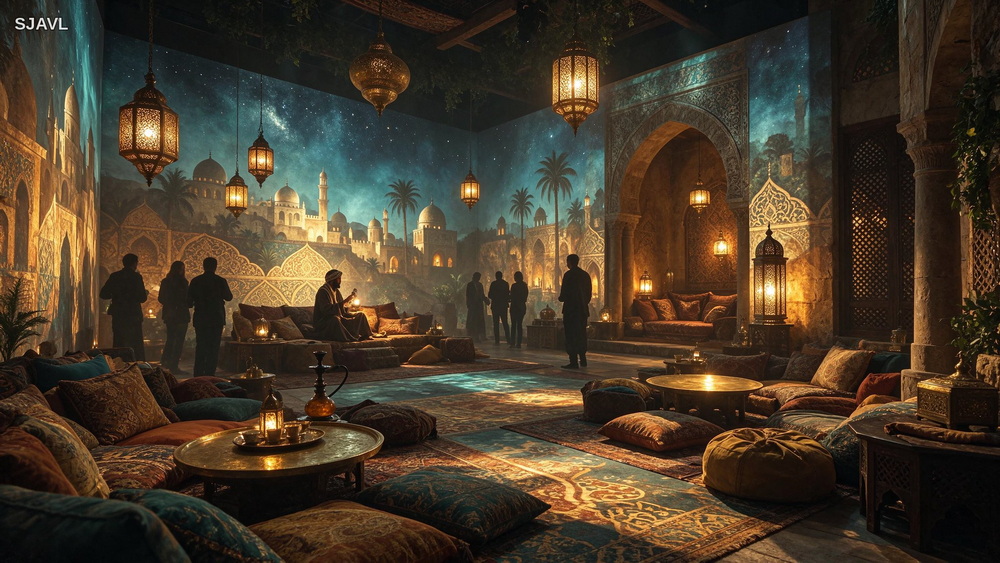
The hakawati was the public narrator of Arab cities and caravan stops, holding court in coffeehouses and souks through long evenings and reciting episodes from The Thousand and One Nights, Bedouin epics and local chronicles to the accompaniment of a single-string rababa, a drum and vocal gesture.
View More